
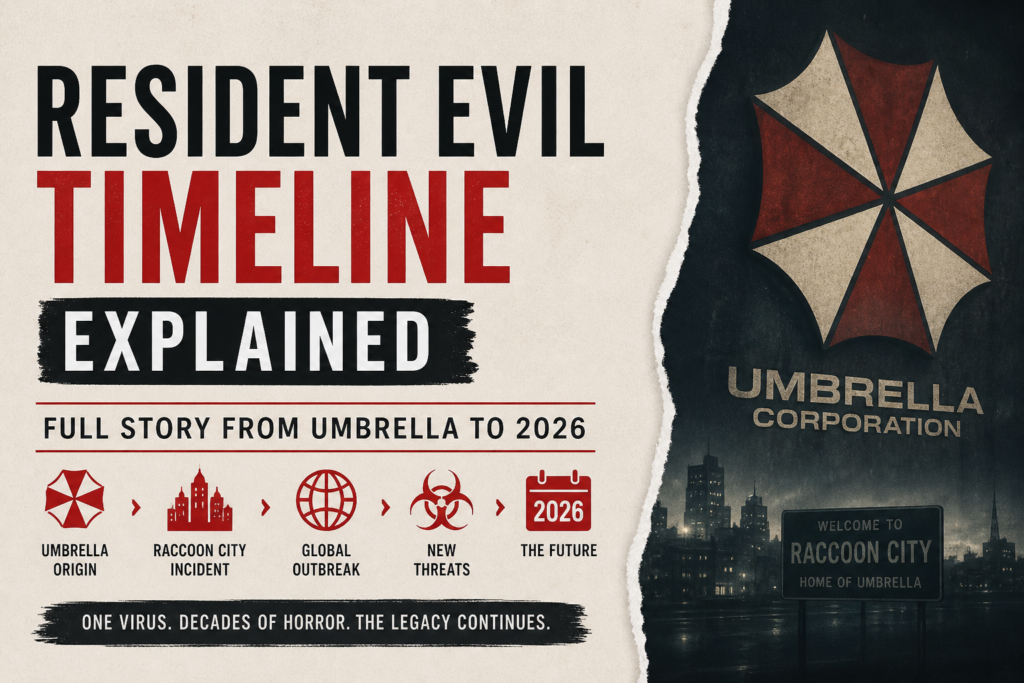
Introduction
The story of Resident Evil timeline is more than just zombies” — Consider changing this to “the Resident Evil timeline is about more than just zombies” for better flow, The Resident Evil universe is one of the most complex and fascinating storylines in gaming and film history. Spanning decades, multiple outbreaks, and countless characters, the timeline can feel confusing — especially for new fans.
From secret experiments by powerful corporations to global viral outbreaks, the story of Resident Evil timeline is more than just zombies. It’s about science gone wrong, human survival, and the consequences of unchecked power.
In this guide, we’ll break down the full Resident Evil timeline explained in a simple and easy-to-understand way — from the origins of the virus to how the story has evolved leading into 2026.
Also read: Resident Evil 2026 Movie – Full Breakdown
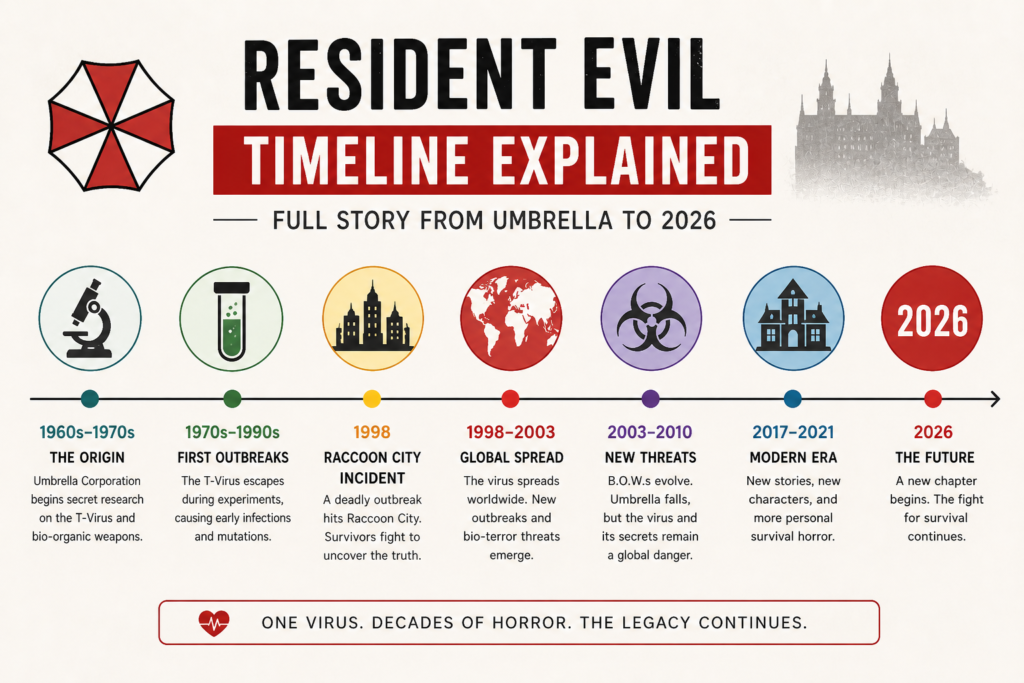
Table of Contents
The Origin: Umbrella Corporation & The Virus
The entire Resident Evil story begins with a powerful and secretive organization known as the Umbrella Corporation.
Founded as a pharmaceutical company, Umbrella secretly conducted illegal experiments on bio-organic weapons (B.O.W.s). Their main goal was to create advanced biological agents that could be used for military purposes.
The most important development was the creation of the T-Virus — a highly dangerous virus capable of reanimating dead tissue and mutating living organisms.
At first, these experiments were hidden from the public. But as testing expanded, things quickly went out of control.
👉 This marked the beginning of the disaster that would eventually spread across the world.
The First Major Outbreak
The first major outbreak occurred when the virus escaped containment during early testing phases.
Initially, incidents were small and isolated — strange illnesses, unexplained deaths, and reports of aggressive behavior. But these were warning signs of something much bigger.
Infected individuals began to lose control, turning into hostile creatures. At the same time, animals and other life forms were mutating into dangerous monsters.
Authorities failed to respond quickly, allowing the infection to spread rapidly.
👉 What started as a controlled experiment soon became a full-scale biological crisis.
The Raccoon City Incident
One of the most iconic events in the Resident Evil timeline is the Raccoon City outbreak.
This incident is considered the turning point of the entire franchise.
The T-Virus spread throughout the city, infecting civilians, law enforcement, and even trained military units. Chaos erupted as the city quickly fell apart.
Key characters like:
- Leon S. Kennedy
- Claire Redfield
- Jill Valentine
played major roles in surviving the outbreak and uncovering the truth behind Umbrella’s experiments.
Despite efforts to contain the situation, the infection became uncontrollable.
👉 Eventually, extreme measures were taken to destroy the city in order to prevent the virus from spreading further.
The Global Spread of the Virus
Even after Raccoon City was destroyed, the threat did not end.
The virus had already spread beyond control, reaching different parts of the world. New variations of the virus began to appear, each more dangerous than the last.
Different organizations and groups attempted to:
- Study the virus
- Control it
- Weaponize it
This led to multiple outbreaks across different regions, turning the crisis into a global issue.
At this stage, the story shifted from a single city disaster to an international biohazard threat.
👉 The world was no longer safe.
Evolution of Bio-Organic Weapons (B.O.W.s)
As research continued, new and more advanced creatures were developed.
These weren’t just zombies anymore.
Umbrella and other groups created:
- Enhanced mutants
- Intelligent bio-weapons
- Creatures with extreme strength and abilities
These B.O.W.s were designed for combat, making them even more dangerous than the original infected.
Over time, the line between science and horror became completely blurred.
👉 Survival was no longer just about escaping infection — it was about facing powerful, engineered threats.
Fall of Umbrella & New Threats
Eventually, Umbrella’s illegal activities were exposed to the world.
Public pressure and global investigations led to the company’s downfall. However, this did not solve the problem.
The research, data, and virus samples did not disappear.
Instead, they spread into the hands of:
- Black market organizations
- Rogue scientists
- Terrorist groups
This created a new wave of bio-terror threats across the globe.
👉 Even without Umbrella, the danger continued to grow.
Modern Era: A More Personal Horror
In later parts of the timeline, the focus shifted from large-scale outbreaks to more personal and isolated horror experiences.
Stories became more intense and psychological, exploring:
- Survival in confined environments
- Human fear and trauma
- Smaller but more terrifying threats
This evolution brought a fresh perspective to the franchise, making it more immersive and emotionally engaging.
👉 Instead of massive wars, the horror became closer and more personal.
Key Characters in the Timeline
The Resident Evil story is driven by strong and memorable characters.
Some of the most important figures include:
Leon S. Kennedy
A government agent who survived the Raccoon City incident and later became a key figure in fighting bio-terrorism.
Claire Redfield
A determined survivor searching for her brother, who played a major role in uncovering Umbrella’s secrets.
Jill Valentine
A skilled operative known for her bravery and leadership during multiple outbreaks.
Chris Redfield
A central figure in combating bio-organic threats across the world.
👉 These characters helped shape the story and gave the franchise emotional depth.
Where Does the 2026 Timeline Fit?
As the Resident Evil universe continues to expand, new stories are being introduced to keep the franchise fresh.
The upcoming 2026 storyline is expected to:
- Explore new perspectives
- Introduce fresh characters
- Stay connected to the original universe
👉 Instead of repeating old events, it may focus on untold stories within the same world.
👉 Also read: Resident Evil 2026 New Movie – Release Date & Full Breakdown
This approach allows both new and old fans to experience the story in a different way.
Why the Timeline Still Matters
Even after many years, the Resident Evil timeline continues to remain relevant.
✔ It connects all games, movies, and adaptations
✔ It builds a deeper understanding of the story
✔ It helps fans follow character development
✔ It adds meaning to every new release
👉 Without understanding the timeline, it’s easy to miss important connections.
What Makes the Story Unique
Unlike many other horror franchises, Resident Evil blends:
- Science fiction
- Action
- Psychological horror
It’s not just about surviving monsters — it’s about understanding how those monsters came to exist.
👉 This combination is what makes the story stand out even today.
Conclusion
The Resident Evil timeline is more than just a series of events — it’s a story about ambition, mistakes, and survival.
From the rise of the Umbrella Corporation to the global spread of the virus, every chapter adds depth to the world and its characters.
As the story moves forward into 2026, one thing remains clear:
👉 The danger may evolve, but it never truly disappears.
What do you think — is the Resident Evil timeline easy to follow, or does it still feel complex?
For more official details about the franchise, visit the official Resident Evil page:
https://www.residentevil.com/