Introduction

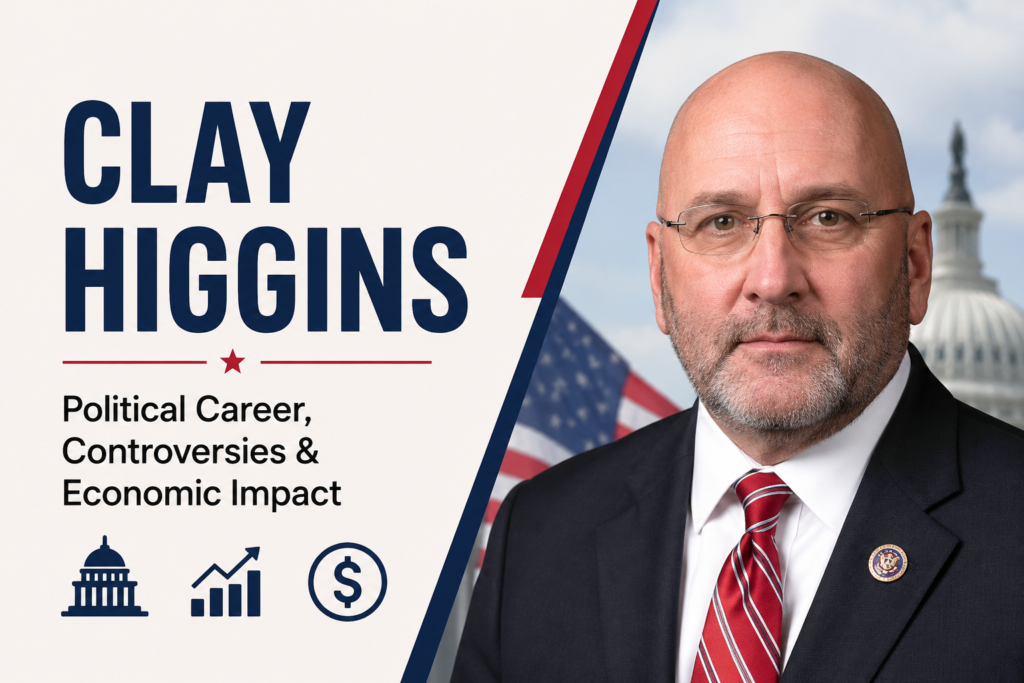
Clay Higgins is one of the most distinctive and polarizing figures in American politics today. Rising from a law-enforcement background in Louisiana, he gained national prominence with arresting “Crime Stoppers” videos and a larger-than-life persona. Since being elected in 2016 as the U.S. Representative for Louisiana’s 3rd District, Clay Higgins has become known for his far-right positions, combative rhetoric, and controversial public statements. In the wake of recent votes—such as his lone “no” vote on the Epstein Files Transparency Act in November 2025—Higgins has found himself back in the national spotlight and under renewed scrutiny. @mathrubhumi+3Al Jazeera+3Hindustan Times+3
In this article we’ll walk through his early life, law-enforcement career, entry into politics, policy views, controversies and what might lie ahead for this enigmatic figure.
Table of Contents
1. Early Life & Background
1.1 Childhood and Roots
Clay Higgins was born on August 24, 1961 in New Orleans, Louisiana. Wikipedia+1 He is the seventh of eight children, and his family moved when he was six to Covington, Louisiana. Wikipedia Growing up, the family raised and trained horses—so Higgins’s roots are fairly rustic, tied to South Louisiana’s rural character.
He graduated from Covington High School and attended Louisiana State University (LSU) though he did not complete a degree. Wikipedia+1
1.2 Military & Early Work
Clay Higgins served in the U.S. Army and in the Louisiana National Guard, in the Military Police Corps. Wikipedia These experiences—military, paramilitary policing—would clearly shape his style and worldview: law-and-order tough talk, direct personal appeal, and a “warrior” persona.
After his military stint, Higgins worked in management of car dealerships for a time, before shifting to law enforcement in full. Wikipedia
2. Law-Enforcement Career: The “Cajun John Wayne” Era
2.1 Patrol Officer to Public Face
In 2004, Clay Higgins became a patrol officer with the Opelousas City Police Department in Louisiana. Wikipedia He then moved to the Port Barre Police Department by 2007. From 2011 to 2016, he served at the St. Landry Parish Sheriff’s Office, eventually becoming Captain and Public Information Officer. Wikipedia+1
As public information officer he began producing weekly “Crime Stoppers” style videos—some standard script, but increasingly with Higgins in his own flamboyant style: threatening suspects by name, calling them “animals”, and employing dramatic visuals. These videos went viral. Wikipedia+1 The national press dubbed him the “Cajun John Wayne” for this tough-guy image. Wikipedia
2.2 Departures & Disputes
However, his law-enforcement career was not without controversy. In 2007, Clay Higgins was accused by his police chief of using unnecessary force on a handcuffed Black man and then giving false statements in the internal investigation. Wikipedia He resigned before disciplinary action could be imposed.
Later, his sheriff voiced concern that his use of uniform in commercial ads (selling security-firm products) violated policy. Clay Higgins reportedly was warned to tone down the “demeaning comments” in his weekly videos and eventually resigned from the sheriff’s office in February 2016. Wikipedia+1
2.3 Style & Public Appeal
What stands out is Clay Higgins’s theatrical law-enforcement style: donning SWAT gear, making direct appeals to criminals, blending media savvy with policing, and building a personal brand. For many in his community it resonated: someone presenting as a stalwart defender of law and order. But for critics it looked like spectacle, self-promotion, and aggressive rhetoric that may cross professional bounds.
3. Entry into Politics
3.1 Running for Congress
In May 2016 Higgins announced his candidacy for the U.S. House representing Louisiana’s 3rd Congressional District. Wikipedia+1 The seat was being vacated by Charles Boustany. Higgins, though resident in the 5th district by residence, legally could run because the U.S. Constitution only requires members of the House live in the same state, not district. Wikipedia
Higgins advanced to the runoff and on December 10 2016 defeated Republican Scott Angelle with 56.1 % of the vote. Wikipedia+1 Thus launched his congressional career.
3.2 Election Victories & Consolidation
Higgins was re-elected in 2018, 2020 and 2022. For example, in 2022 he captured about 64.3 % of the vote. Wikipedia+1 In 2024 he was re-elected with 70.6 % of the vote, showing increasing strength in his district. Wikipedia+1
3.3 Congressional Style
From the start Higgins leaned into his law-enforcement image: arriving in uniformed contexts, referencing his “captain” title, and emphasizing “law and order”, “secure borders”, “defender of the people” narratives. On his congressional website he identifies as a core member of the House Freedom Caucus and highlights his “Constitutionalist principles”. Congressman Clay Higgins
4. Political Positions & Voting Record
4.1 Ideological Stance
Higgins is widely regarded as being on the far-right wing of the Republican Party. He has aligned with populist, nationalist, and “America First” themes. For example, outlets describe him as a strong Trump supporter. Al Jazeera
He emphasizes smaller government, lower taxes, secure borders, individual freedoms, and aggressive law-and-order policies. Congressman Clay Higgins
4.2 Major Policy Areas
Abortion: Higgins is firmly anti-abortion and has invoked strong language, even comparing abortion to the Holocaust. Wikipedia
COVID-19 & Public Health: During the pandemic, Higgins was a vocal skeptic of mask mandates and vaccine mandates. For example, he described masks as “bacteria traps” and opposed employer vaccine mandates. Wikipedia
Environment & Agencies: In December 2024 he sponsored a bill (H.R. 10549) that would abolish the Environmental Protection Agency (EPA). Wikipedia
Gun Rights: He supports broad gun rights, opposes major regulation of firearms, and has made statements endorsing use of firearms for political confrontation. Wikipedia
Immigration & National Security: Higgins supported President Donald Trump’s 2017 travel ban on several Muslim-majority countries and in 2022 opposed a resolution condemning Russia’s abduction of Ukrainian children; he also introduced legislation to prohibit transfer of missile systems to Ukraine. Wikipedia+1
4.3 Recent Controversial Vote: Epstein Files
On November 18 2025 Higgins was the sole member of the U.S. House of Representatives to vote against the Epstein Files Transparency Act, which would force the release of files related to convicted sex offender Jeffrey Epstein. The bill passed 427-1. Hindustan Times+1
In his public statement, Higgins said:
“What was wrong with the bill three months ago is still wrong today. It abandons 250 years of criminal justice procedure in America.” Hindustan Times
This vote and his explanation stirred fresh scrutiny of his principles and alliances.
5. Public Persona & Rhetoric
5.1 Communication Style
Higgins’s public brand is unmistakable. He often uses dramatic imagery, forceful language, and a confrontational tone. His law-enforcement past gave him a platform from which he could portray himself as a “warrior” against crime and then build that brand into politics.
He has admitted to sleeping on an air mattress on the floor of his Capitol Hill office, working out and showering in the House gymnasium—a self-crafted image of the ascetic, dedicated public servant. Wikipedia
5.2 Engagement with Militia/Fringe Groups
Higgins has been linked to, or spoken at, events associated with militia movements and off-shoots. For example, he has appeared and spoken for the Oath Keepers and publicly claimed to be a member of the Three Percenters. Wikipedia
This kind of association places him firmly outside the mainstream both in tone and in symbols he uses.
5.3 Media and Meme Culture
Because of his personality and use of viral videos in his prior career, Higgins has become a media figure. His “Crime Stoppers” videos went viral; his rhetoric often catches attention beyond his district; he is a spectacle as much as a legislator.
But that also means controversies stick. His flare for dramatic statements makes him prone to public criticism over tone, substance and behaviour.
6. Controversies & Criticisms
6.1 Law Enforcement Past
The 2007 allegation of unnecessary force and false statements when Higgins was with Opelousas PD is a notable stain in his record. Wikipedia Also issues around his wearing of uniform in advertisements, and the question of mixing private gain with public service, raised ethical concerns. Wikipedia
6.2 Social Media Posts & Statements
Higgins has made multiple posts that drew criticism:
- In June 2017, after a terror attack in London, he posted a Facebook message saying: “Kill them all. … For the sake of all that is good and righteous.” Wikipedia
- In September 2024 he posted a tweet (later removed) disparaging Haitian immigrants, calling them “wild… nastiest country in the western hemisphere…”, leading the Congressional Black Caucus to call for his censure. New York Post
These incidents have raised concerns about his rhetoric, bias, and fitness for office.
6.3 Voting & Alliances
Higgins’s vote against the Epstein Files bill in November 2025 triggered a wave of commentary: Why was he the only “no” vote? What does it say about his stance on transparency in high-profile cases? Some media described it as evidence of positioning “on the extreme edge” of the Republican Party. Al Jazeera+1
Critics argue his alignment with militia-adjacent groups and his frequent rhetoric of “us vs them” contribute to polarization rather than constructive governance.
7. Constituency & District: Louisiana’s 3rd
7.1 District Profile
Louisiana’s 3rd Congressional District covers much of southwestern Louisiana, including areas such as Lafayette, Lake Charles and New Iberia. Wikipedia+1 It is a largely rural and semi-urban district, with strong conservative leanings.
7.2 Electoral Strength
Higgins’s repeated re-elections—with growing margins—show he has secured a strong base in his district. The 2024 election saw him win with 70.6 % of the vote. Wikipedia+1
His brand—as tough on crime, defender of the South Louisiana way of life, speaker for conservative values—resonates with many in his district.
7.3 Constituent Services & Local Focus
On his official site, Higgins emphasises constituent services, flag requests, casework and local outreach. Congressman Clay Higgins He attends to issues such as agriculture, energy (important for Louisiana), border security, and law and order—all of which align with district interests.
8. Recent Developments & What’s Ahead
8.1 2024 Re-Election & 2026 Outlook
Higgins secured his seat again in 2024, reinforcing his strong standing in the district. Wikipedia+1 As of early 2026, he is expected to continue in office rather than seeking higher office, according to state political watchers. Wikipedia
8.2 Spotlight on Transparency & Governance
His lone “no” vote on the Epstein Files Transparency Act thrust Higgins into a new spotlight. Many are questioning his rationale and his broader views on government transparency and accountability. This could shape his national profile going forward. Al Jazeera+1
8.3 Local and National Ambitions
While Higgins remains focused on his district, his style and prominence could lead to national ambitions—or increased roles in congressional committees. His law-enforcement credentials and Republican alignment give him a platform for national law-and‐order narratives.
8.4 Reputation & Risk
However, Higgins’s reputation is a double-edged sword. His base admires his bluntness and “no-nonsense” stance. But the controversies—social-media posts, law-enforcement past, links to militia-associated groups—create risks for broader influence and public image. How heManage’s them will influence his future.
9. Analysis: Strengths, Weaknesses & Implications
9.1 Strengths
- Strong electoral base in his district, with increasing vote shares.
- A distinctive personal brand that stands out in politics.
- Deep law-enforcement/“tough on crime” credentials which fit many voters’ values in his region.
- Ability to command media attention and mobilize support.
9.2 Weaknesses
- Controversial statements and social-media incidents that attract negative attention and may limit his ability to pivot to broader roles.
- Alignments (or perceived alignments) with extremist groups reduce credibility among moderates and detract from coalition-building.
- The “spectacle” approach may overshadow legislative substance or governance focus.
- Transparency issues—such as the Epstein-files vote—raise questions about his positions on openness and accountability.
9.3 Broader Implications
Higgins exemplifies a trend in American politics: law-enforcement or military backgrounds turned into populist political brands; an emphasis on viral media and persona; and a willingness to inhabit the fringes of mainstream discourse. His career offers a case study in how political style can carry someone far—yet also create headwinds if ambition rises.
For the Republican Party, Higgins reflects both a strength (energizing a base, emphasizing security, traditional values) and a risk (polarization, controversies, charisma over policy). For Louisiana, he’s a figure who brings attention—and sometimes turbulence—to the 3rd District.
10. What to Watch Going Forward
- Committee Assignments & Influence – Will Higgins gain more powerful committee roles or take on high-profile investigations?
- Legislative Output – Beyond rhetoric, what bills will he champion? Will he focus on substantive policy or continue with style?
- Public Image Management – How will he handle controversies, social-media backlash, and calls for censure? His response may determine his national reach.
- 2026 & Beyond – Will Higgins aim for higher office (e.g., Senate) or deepen his role in the House? Will his base remain loyal if his national profile shifts?
- Shifts in District Dynamics – While currently strong, demographics and political winds may shift. How will he adjust?
FAQs
Q1: Where does Clay Higgins stand on abortion?
A1: He is strongly anti-abortion and has used strong language in comparing abortion to atrocities, emphasizing protection of unborn life.
Q2: What was the controversy around Higgins’s law-enforcement career?
A2: In 2007, while a patrol officer in Opelousas, he was accused of using unnecessary force on a handcuffed suspect and lying about it. He resigned before formal disciplinary action. Wikipedia
Q3: Why was Higgins the only congressman to vote against the Epstein Files Transparency Act?
A3: He argued that the bill “abandons 250 years of criminal justice procedure” and would harm innocent people by broadly releasing investigative files. Hindustan Times+1
Q4: What is Higgins’s association with militia groups?
A4: Higgins has spoken at events tied to groups like the Oath Keepers and publicly claimed membership in the Three Percenters, which has raised concerns about him being aligned with anti-government militia-adjacent movements. Wikipedia
Q5: How popular is he in his district?
A5: Very popular. In 2024 he won reelection with approximately 70.6 % of the vote in Louisiana’s 3rd District. Wikipedia+1
Q6: Has Higgins indicated plans for higher office?
A6: As of early 2026, reports suggest he is not running for Senate and remains focused on his House seat. Wikipedia
Conclusion
Clay Higgins is a figure of contrasts: rugged law-enforcement roots and viral bravado; electoral strength in his district yet national controversies; a staunch conservative voice and a frequent target of criticism. He thrives in the realm of strong imagery and bold rhetoric, but his future may depend on whether he can pair that persona with legislative substance and navigate the pitfalls of public controversy.
In the evolving landscape of American politics—where media, identity, ideology and performance all intersect—Higgins stands as a striking example of the modern populist politician. Whether that prominence translates into lasting legacy, greater power or deeper influence remains to be seen. But for now, in the 3rd District and on the national stage, Clay Higgins is very much a player to watch.
For more detailed coverage across different topics, including our latest TwitterDown, visit our featured content hub.
1 thought on “Clay Higgins: From Cajun Lawman to Controversial Congressman”