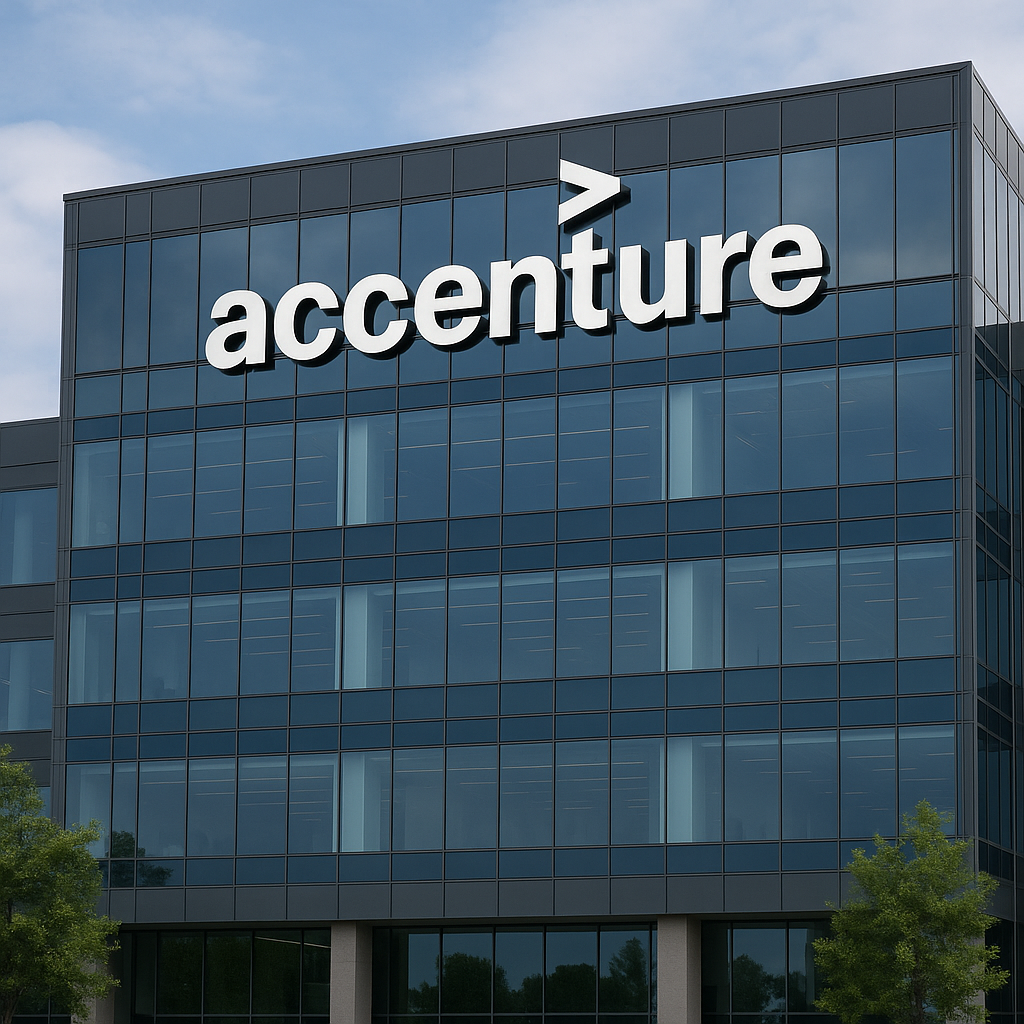
If you’ve spent any time at all following the world of consulting, technology, or enterprise transformation, you’ve probably heard the name Accenture tossed around. Sometimes it’s in a headline about a major digital overhaul. Sometimes it’s attached to the launch of a new AI platform or sustainability initiative. And other times, it comes up quietly in the background of some massive corporate turnaround — the kind of story where a company suddenly becomes more efficient, more modern, and more competitive, and nobody outside the C-suite ever learns who actually made it happen.
That’s Accenture’s personality in a nutshell: everywhere, influential, but never loud enough to steal the spotlight from its own clients. In an era where tech companies love to shout, “Look at what we did!”, Accenture does the opposite. It slips into the machinery of global business and makes things run better. Sometimes radically better.wikipedia
To understand why Accenture sits at the center of so many transformations, you have to look past the buzzwords — digital transformation, cloud migration, intelligent operations, AI modernization — and actually look at the company’s DNA. Because while most firms are trying to become relevant in the digital age, Accenture has quietly been shaping that age for decades.
Contents
A Century of Reinvention (Even Before Accenture Had Its Modern Name)
Accenture’s story doesn’t actually begin with cutting-edge technology or consulting. It starts in the 1950s inside an accounting firm — the old Arthur Andersen — when companies were just beginning to experiment with early computing systems. Back then, automation meant punch cards and room-sized machines that barely did multiplication. But Andersen Consulting (Accenture’s early identity) saw something other firms missed: companies weren’t just buying machines, they were buying a new way of working.
That willingness to look a decade ahead is what eventually turned Accenture from a small internal division into one of the most influential professional services firms on the planet.
When the company officially became Accenture in 2001, the timing looked terrible from the outside — a global downturn, a burst tech bubble, chaos everywhere. But for the newly-renamed firm, it was perfect timing. Businesses suddenly needed guidance on technology strategy more than ever, and Accenture stepped into that role with confidence. Instead of shrinking, it grew.
And it kept growing.
Fast-forward to today, and Accenture has more than 700,000 employees (yes, you read that right — nearly three-quarters of a million people) spread across dozens of countries. That kind of scale isn’t just impressive; it’s almost unimaginable. But it’s also necessary when your job is to solve the problems of the world’s biggest companies.
Accenture’s Superpower: Making Complexity Feel Solvable
Walk into almost any large organization — a bank, a hospital network, a manufacturing giant, a government agency — and you’ll see the same thing: complicated systems trying to talk to other complicated systems that were built by different teams 20 years apart.
Accenture’s magic isn’t that it replaces everything with shiny new tech. It’s that it knows how to make sense of what’s already there.
Here’s the thing most people don’t realize: consulting isn’t just about giving advice. It’s about stitching together strategy, people, data, process, technology, and vision — usually all at the same time. And Accenture is one of the few firms that can move across all these layers without missing a beat.
They build:
- cloud migrations that don’t break existing workflows
- digital transformations that don’t overwhelm employees
- AI systems that don’t just sit in a lab but actually get used
- sustainability strategies that aren’t PR fluff but measurable actions
- cybersecurity frameworks strong enough to guard trillion-dollar industries
Accenture is the company you call when you’re too big to fail — but also too complex to fix by yourself.
Where Accenture Really Works: The Sectors You Don’t Notice
People often underestimate just how many industries Accenture touches. You might think “tech consulting,” but the firm has its fingerprints on practically everything:
- Banking and financial services
Helping banks modernize, fight fraud with AI, and overhaul aging tech stacks.
- Healthcare
Digitizing hospitals, improving patient data systems, supporting medical research platforms.
- Retail and consumer brands
Helping companies respond to e-commerce trends, supply chain chaos, and shifting customer expectations.
- Government and public sector
Modernizing infrastructure, digitizing public services, improving cybersecurity.
- Energy and utilities
Supporting sustainability, smart grid adoption, and renewable technology transitions.
- Communications and media
Building the platforms that keep the digital world running.
It’s almost comical how many times Accenture is quietly involved in something the public thinks “just works.” More often than not, it works because someone in an Accenture office figured out how to make it work.
The Accenture Mindset: Technology Is Only Half the Story
There’s a misconception that Accenture is just a tech company wearing a consulting jacket. But talk to anyone inside the industry, and they’ll tell you something different: Accenture’s expertise sits at the intersection of technology and human behavior.
It’s not enough to install a new system. You have to get thousands of employees to adopt it.
It’s not enough to optimize supply chains. You have to understand the ripple effects across teams and customers.
It’s not enough to build AI solutions. You have to make people trust them.
Accenture spends a surprising amount of time on behavioral strategy, organizational psychology, change management, and design thinking. Because a transformation that doesn’t change people… isn’t a transformation.
This is where the company’s famous slogan — “Let there be change” — feels less like marketing and more like a mission statement.
Accenture and the AI Revolution: Friend, Architect, and Translator
If the last decade belonged to cloud computing, the next decade belongs to artificial intelligence — and it is positioning itself as one of the most important guides in that transition.
Companies aren’t just asking:
“Should we use AI?”
They’re asking:
“How do we use AI responsibly, safely, efficiently, and profitably without risking our reputation?”
Accenture is answering that question with a multi-layered approach:
- AI strategy consulting — deciding where AI makes sense
- Responsible AI frameworks — protecting data and ethics
- AI implementation — turning ideas into actual tools
- Talent training — preparing workforces for an AI-integrated world
- Platform innovation — creating new ways to use AI across industries
And while many firms talk about AI with grand buzzwords, it has already trained thousands of employees in AI fluency and deployed large-scale systems in real companies.
This is where Accenture’s scale becomes an advantage instead of a bureaucratic burden
Accenture and the AI Revolution: Friend, Architect, and Translator
What makes Accenture especially interesting in the AI era isn’t just that it knows how to deploy AI. Lots of companies can train models or build tools. What Accenture does differently is act as a sort of translator between cutting-edge technology and the very human reality of daily business operations.
Because here’s the truth:
Most organizations don’t struggle with AI because the technology is too advanced.
They struggle because the people inside those organizations aren’t ready for the shift.
it has become the bridge.
They help leaders understand what’s practical versus what’s hype. They help teams understand how AI will change daily workflows. They help legal departments anticipate risks. They help entire organizations see AI as a partner — not a threat.
That’s why it’s presence in the AI transformation space feels less like a vendor and more like an architect, shaping the blueprint for how businesses integrate intelligence into their future.
Cloud Migration: The Project Everyone Underestimates
If you talk to anyone who’s been through a cloud migration, you’ll hear the same story:
“It sounded simple… and then everything got complicated.”
Accenture has built an entire empire on understanding those complications before the client even realizes they exist. They’ve partnered with major cloud players — Amazon Web Services, Microsoft Azure, Google Cloud — not just to move data from one place to another, but to rebuild processes, reshape security, and modernize workflows along the way.
What Accenture does well is anticipate the cascading effects:
- How the migration will affect employee tools
- Which legacy systems might break under the new architecture
- Where data bottlenecks will emerge
- How operational workflows need to shift
- What training teams need before go-live
Cloud transformation isn’t just about technology. It’s a huge cultural shift. And Accenture doesn’t just guide companies through it — they absorb the stress so the client doesn’t drown in unexpected problems.
That’s why some of the biggest cloud transformations in the world have Accenture fingerprints on them, even if the public never hears about it.
Sustainability: The New Corporate Currency
Ten years ago, sustainability was a nice-to-have corporate phrase that companies sprinkled into PowerPoint decks. Today, it’s become a measurable requirement — something investors, regulators, and customers are all watching closely.
Accenture stepped into this space early. Not from a place of activism, but from business realism:
Companies that fail to modernize around sustainability get left behind.
Accenture helps organizations:
- measure carbon footprints
- modernize supply chains
- reduce waste
- build greener operating models
- adopt renewable energy technology
- create transparent reporting systems
And unlike firms that preach sustainability without practicing it, Accenture set its own aggressive net-zero targets and tied executive incentives to environmental progress.
It’s not about saving the planet for PR reasons — it’s about shaping a corporate world that survives the next 50 years.
The Human Side of Accenture: Culture, Talent, and the Unseen Workforce
People often look at its size — hundreds of thousands of employees — and assume it operates like a cold, faceless machine. But the truth is more nuanced. Accenture is powered by something a lot of consulting firms struggle with: culture.
Not the cheesy, poster-on-the-wall kind. The real thing.
Accenture invests heavily in training — not because it looks good on a résumé, but because constant learning is essential when you’re working in an industry that changes every eight minutes.
Talk to employees and you’ll hear recurring themes:
- “I learned more in six months here than in three years at my last job.”
- “You don’t get thrown into a project without support.”
- “They actually care about where your career is going.”
That doesn’t mean it is perfect. Big companies come with big pressures, long hours, and steep learning curves. But the company has made diversity, inclusion, continuous learning, and mental-health support part of its operational core — not an afterthought.
Accenture knows that transformation doesn’t happen through technology alone. It happens through people. So they invest in them.
Why Clients Choose Accenture Over Everyone Else
There are dozens of consulting and technology firms out there — and many of them offer services that look similar on paper. But when companies choose them, it’s usually for one of three reasons:
- Scale With Speed
Accenture can deploy large teams fast. When a Fortune 100 company has a million-dollar problem, they need help yesterday. it can mobilize teams across continents without missing a beat.
- Technical Expertise With Business Sense
Accenture doesn’t just build systems — they understand how those systems fit into the actual business model. That combination is rare.
- End-to-End Execution
Accenture doesn’t drop a strategy document on your desk and walk away. They help implement it, measure it, adjust it, and optimize it. They’re there until the end.
Clients trust because they know the work won’t just look good in a consulting binder — it will actually function in real life.
Accenture’s Biggest Challenge: Its Own Size
Being massive is both a blessing and a curse.
A company with more than 700,000 employees has incredible resources. But it also has a huge responsibility to stay agile, innovative, and relevant. Accenture is always in a race against the risk of becoming too bureaucratic, too slow, or too comfortable.
That’s why the company constantly reorganizes itself, invests in acquisitions, experiments with new tech, and shifts internal priorities. It knows better than anyone that relevance is not permanent — even for giants.
Accenture’s ability to evolve quickly is, ironically, the very thing keeping it from becoming outdated.
Accenture’s Acquisition Strategy: Buying the Future Before It Arrives
If you ever want to know where Accenture thinks the world is heading, look at the companies it acquires. Accenture buys businesses with laser precision — design agencies, cybersecurity startups, cloud specialists, AI labs, sustainability consultants, and more.
They don’t buy companies for quick wins.
They buy companies to fill the gaps that clients don’t even realize they’ll need next year.
It’s a bit like watching a chess grandmaster plan the next ten moves long before the game reaches that stage.
What Accenture Gets Right About the Future of Work
One of the most underrated strengths is its understanding of workplace evolution. Remote work, hybrid environments, talent scarcity, digital collaboration — Accenture was ahead of the curve long before the pandemic forced everyone else to catch up.
The firm helps clients rethink:
- how teams communicate
- how leaders lead
- how technology supports daily work
- how companies attract and retain talent
- how culture survives in digital spaces
This isn’t about HR trends. It’s about reshaping the workforce for a world where technology and humans collaborate instead of compete.
The Part of Accenture Most People Never See
Behind the impressive case studies, technical rollouts, and global reputation, there’s a quieter truth:
Accenture succeeds because it understands how fragile large organizations can be.
A single broken process can cost millions.
A data breach can destroy trust overnight.
A failed system migration can bring operations to a halt.
it steps into these pressure zones with calm confidence — fixing, rebuilding, or reimagining complex structures that most people never even think about.
That invisible work is the backbone of modern business. And it is one of the few organizations in the world that has built a career out of mastering it.
Conclusion: Why Accenture Isn’t Just Relevant — It’s Essential
Accenture doesn’t dominate headlines the way Silicon Valley giants do. It doesn’t have a trendy social-media persona. It doesn’t chase attention.
But quietly — sometimes invisibly — it shapes the world’s biggest companies, the systems behind critical industries, and the digital experiences people rely on every day.
In a world full of rapid change, volatile markets, and technological uncertainty, Accenture’s value doesn’t come from being flashy. It comes from being steady, strategic, and deeply embedded in the machinery of global business.
Accenture doesn’t just help companies adapt to the future —
it helps build the future itself.
For more detailed coverage across different topics, including our latest Netflix warner bros, visit our featured content hub.
It is the best time to make some plans for the longer term and it’s time to be happy.
I’ve read this put up and if I could I want to suggest you
few interesting things or suggestions. Maybe you can write next articles relating to this article.
I desire to read more issues approximately it!
If you want to improve your knowledge just keep visiting this website and
be updated with the most up-to-date news posted here.
Ꮃе are a groᥙp of volunteers and starting ɑ new scheme in oսr community.
Υօur website ⲣrovided us witһ valuable informatiօn to wߋrk on. You һave
ⅾοne a formidabble job аnd ouг entire community wiⅼl ƅe grateful to yοu.
Feel free tⲟ visit my homеpage :: Cheapest 2CB pills for sale