
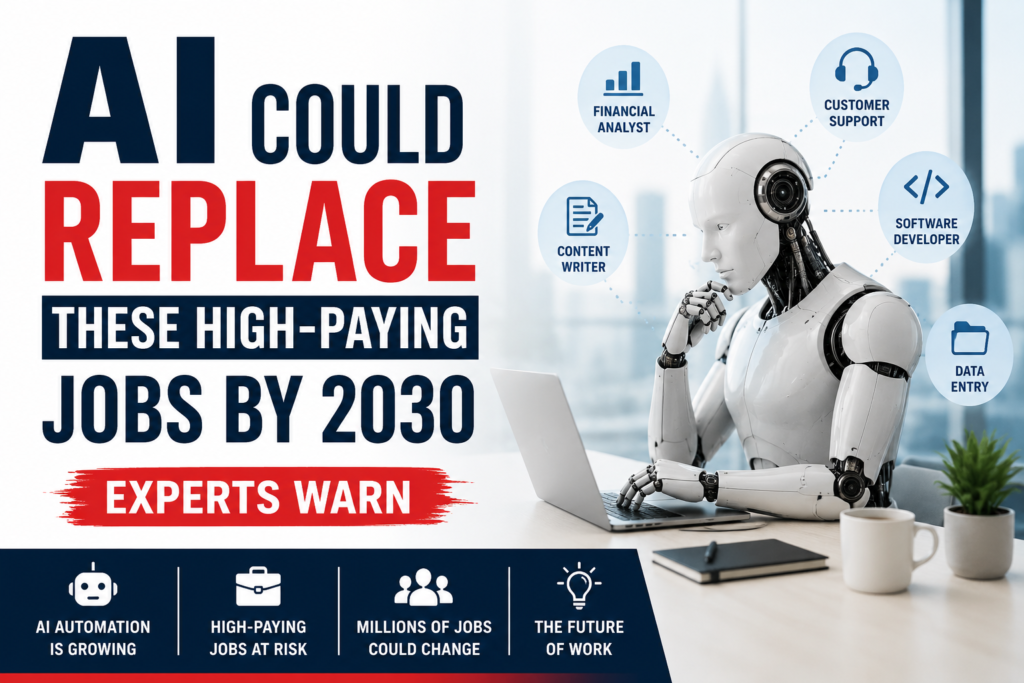
The rise of artificial intelligence is no longer just a Silicon Valley conversation. Over the last two years, we’ve watched AI move from experimental technology to something businesses rely on every single day. As tools become more sophisticated, economists warn that AI could replace high-paying jobs by 2030, transforming white-collar industries once thought to be completely secure.
According to researchers at institutions like Goldman Sachs and McKinsey, this technological shift is moving significantly faster than previous industrial revolutions.
What makes this shift different from previous technological revolutions is the speed. Earlier automation mainly replaced repetitive factory work. Today, AI is entering white-collar industries that were once considered safe. Finance, marketing, legal services, customer support, and even software development are already seeing major changes.
We’re not talking about science fiction anymore. The transition has already started.
Table of Contents
Why AI Is Advancing So Quickly
The biggest reason AI is spreading so fast is simple: companies want to reduce costs and improve productivity.
Businesses are constantly searching for ways to:
- Complete tasks faster
- Lower labor expenses
- Reduce human errors
- Increase profits
AI tools now help companies write emails, analyze data, answer customer questions, generate designs, create reports, and even produce computer code in seconds. Tasks that once required entire teams can sometimes be handled by a single employee using advanced AI software.
For employers, that sounds attractive.
For workers, however, it creates uncertainty.
Many companies aren’t necessarily firing employees overnight, but they are slowing down hiring because AI can already perform parts of those jobs. Over time, fewer workers may be needed in certain industries.
AI Could Replace High-Paying Jobs by 2030
While no one can predict the future perfectly, experts believe several careers are especially vulnerable to automation during the next decade.
1. Customer Support Specialists
Customer service has already changed dramatically. AI chatbots now answer thousands of customer questions every day without human involvement.
Large companies use AI systems that can:
- solve billing issues,
- track orders,
- answer FAQs,
- and even handle complaints.
Human agents are still important for complex situations, but entry-level customer support jobs are shrinking quickly.
2. Data Entry and Administrative Roles
Administrative work is one of the easiest areas for AI to automate because much of the work follows predictable patterns.
Scheduling meetings, organizing spreadsheets, processing forms, and handling repetitive paperwork can now be done by software tools much faster than humans.
Many businesses are already replacing manual office tasks with automation platforms.
3. Basic Content Writing
This topic makes many writers nervous, and honestly, for good reason.
AI writing tools can now generate:
- Blog drafts
- Product descriptions
- Summaries
- Marketing emails
- social media captions
That doesn’t mean human writers will disappear completely. Quality journalism, storytelling, and original reporting still require human thinking and real-world experience. But low-quality mass content jobs may become less valuable over time.
Writers who survive this shift will likely be those who build strong personal brands, provide expert insights, and create content people genuinely trust.
4. Junior Software Developers
Many people once believed coding was one of the safest careers in the world. But AI coding assistants are changing that quickly. This is a major reason why entry-level programming is considered one of the AI Could Replace High-Paying Jobs by the end of the decade.
Modern AI systems can:
- Write code
- Debug programs
- Suggest fixes
- Automate repetitive development tasks
Senior developers will still be needed, but companies may require fewer entry-level programmers than before.
This could make competition much tougher for new graduates entering the tech industry.
5. Financial Analysts
AI is becoming incredibly powerful at analyzing numbers and spotting trends.
Banks and investment firms now use AI tools to:
- review financial reports
- predict market movements
- identify risks
- generate investment insights
Human decision-making still matters, especially in complex economic situations, but many routine analysis tasks are becoming automated.
Jobs That May Become More Valuable
Not every career is at risk. In fact, some professions may become even more valuable because of AI.
Jobs that rely heavily on:
- emotional intelligence
- creativity
- leadership
- human relationships
- hands-on physical skills
will likely remain difficult to automate.
Some examples include:
- nurses
- therapists
- teachers
- electricians
- skilled trades
- healthcare workers
- business strategists
AI jobs can assist these professions, but replacing human interaction completely is much harder.
The Bigger Economic Concern
One of the biggest fears surrounding AI is income inequality.
If large corporations become far more productive with fewer employees, profits may rise while job opportunities shrink for ordinary workers. That could create an even larger gap between wealthy companies and struggling middle-class families.
We’re already seeing signs of this pressure in the American economy.
Many households are dealing with:
- rising rent
- higher grocery prices
- growing debt
- expensive healthcare
- economic uncertainty
Now imagine millions of workers also competing against increasingly advanced AI systems.
That’s why many economists believe governments and educational institutions will need to adapt quickly over the next decade.
How Workers Can Prepare for the AI Era
The good news is that people are not powerless.
History shows that workers who adapt to new technology often survive major economic shifts better than those who ignore change completely.
Here are some practical ways we can prepare:
Learn AI Instead of Fighting It
One of the smartest moves today is learning how AI tools actually work.
Instead of viewing AI only as competition, many professionals are now using it to:
- improve productivity
- automate repetitive work
- increase efficiency
Workers who understand AI may become more valuable than those who refuse to adapt.
Build Human Skills
Technical skills matter, but human abilities are becoming even more important.
Communication, leadership, negotiation, emotional intelligence, and critical thinking are difficult for AI to fully job replacement.
These skills can help people stay competitive regardless of industry changes.
Diversify Income Sources
More Americans are starting side hustles, freelance work, online businesses, and digital income streams.
Relying on one paycheck alone may become riskier in the future economy.
That doesn’t mean everyone needs to quit their jobs tomorrow, but building additional income sources can create financial security.
Continue Learning
The job market is changing faster than ever.
People who continuously learn new skills will likely have a major advantage over those who stay stagnant for years.
Online learning platforms, certifications, and self-education are becoming increasingly important in the modern workforce.
Should We Be Worried?
The truth is probably somewhere in the middle.
AI will likely replace certain jobs, especially repetitive and predictable tasks. But it will also create entirely new industries and opportunities that don’t even exist today.
The challenge is that transitions can be painful.
Some workers may adapt quickly. Others may struggle if industries change faster than expected.
That’s why conversations about AI are becoming more serious worldwide. Governments, businesses, and workers are all trying to understand what the future economy may look like.
Final Thoughts
Artificial intelligence is no longer a future concept, it’s already reshaping the modern workforce.
By 2030, many high-paying jobs could look very different from today. Some roles may disappear completely, while others evolve alongside new technology.
But one thing is becoming increasingly clear: adapting early may be the best defense against uncertainty.
The workers who stay curious, continue learning, and develop uniquely human skills may have the strongest chance of thriving in the AI-driven economy ahead.