
Introduction
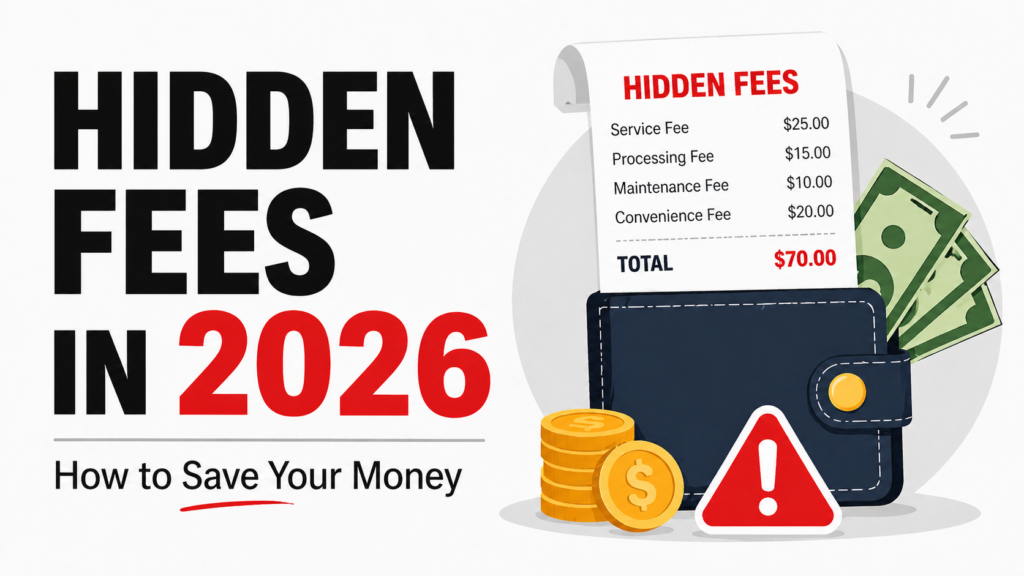
In 2026, the American economy feels like a moving target. While we are all hyper-aware of the surging prices at the gas pump and the grocery checkout line, 2026 hidden fees quietly drain hundreds to thousands of dollars from American households every year—often without people even noticing.
Think of your bank account like a bucket. You’re working hard to fill it up, but hidden fees are like tiny pinholes in the bottom. Individually, they don’t look like much—a $3 service charge here, a $12 “convenience fee” there—but by the end of the year, these pinholes can drain thousands of dollars. If you want to truly save money, you have to stop looking only at the big numbers and start plugging the small leaks.

Table of Contents
Why “Drip Pricing” is the Enemy
Before we dive into the specific fees, it’s important to understand why this is happening. In marketing, this is called “Drip Pricing.” Companies lure you in with a low “headline price” to get you through the door, then “drip” extra charges onto the total during the checkout process.
According to recent consumer protection insights from the Federal Trade Commission (FTC), these deceptive pricing tactics cost Americans billions annually. Humans hate losing out on a deal once they’ve committed mentally, so we usually just click “pay” even when the price jumps by 30%. In 2026, this has become the standard operating procedure for almost every industry in the US.
What Are Hidden Fees?
Hidden fees are unexpected or unclear charges added to products or services. They are often not clearly visible upfront and may appear only at checkout or on your monthly statement.
These fees are common across industries such as banking, subscriptions, travel, and online shopping.
The Banking Trap: Fees for Holding Your Own Money
It’s ironic that the places meant to keep our money safe often take the most from us. In 2026, traditional “brick-and-mortar” banks have increased their overhead costs, and they pass those onto you.
- The “Maintenance” Myth: Many banks charge $12–$25 a month just for the “privilege” of having an account. Over a year, that’s $300 gone for zero added value.
- The ATM Double-Dip: If you use an out-of-network ATM, your bank charges you, and the ATM owner charges you. You could be paying $6–$8 just to access $20 of your own cash.
- The Overdraft Shell Game: Even with modern regulations, banks often reorder your transactions so the largest one hits first, potentially triggering multiple overdraft fees in a single day.
Human Advice: Don’t be loyal to a bank that charges you to exist. 2026 is the year of the Digital Neobank. Look for institutions that offer “No-Fee” guarantees. You can compare the best high-yield, low-fee options at Bankrate to ensure your money is actually working for you.
.
2. Subscription Auto-Renewal Fees
In 2026, most people don’t realize how many subscriptions they’re paying for—until they actually check their bank statement. From your car’s heated seats to your toothbrush head replacements, everything is a monthly bill. The danger here isn’t the $10 fee; it’s the “Zombie Subscription.”
- The “Free” Trial Hook: Companies know that 70% of people will forget to cancel a free trial. They bank on that one month of “accidental” revenue.
- Tiered Inflation: Have you noticed your streaming services adding “Ad-Free” tiers that cost $5 more every six months? It’s a slow creep that most people don’t track.
The Fix: Use a dedicated “Subscription Audit” day. On the first Saturday of every month, look at your credit card statement. If you didn’t use a service in the last 30 days, kill it. You can always resubscribe later, but you can never get that “zombie” money back.
3. Delivery and Service Fees
In our fast-paced 2026 lifestyle, we pay for time. But the gap between the menu price and the final receipt on delivery apps has become a chasm.
- The Service Fee vs. Delivery Fee: Most users don’t realize these are two different things. Neither of them usually goes to the driver.
- Inflationary Menu Prices: Many restaurants upcharge items by 15–20% on apps to cover the platform’s commission. You’re being hit three times: higher base price, delivery fee, and service fee.
Human Advice: If you live within two miles, pick it up. Not only do you save the $10–$15 in fees, but the food is fresher, and you’re actually supporting the local business instead of a tech giant’s bottom line.
4. Travel in 2026: The “Unbundled” Nightmare
Airlines have perfected the art of the hidden fee. They now treat a flight like a Lego set—you have to pay for every individual piece.
- Carry-on “Gotchas”: Some budget airlines now charge more for overhead bin space than for the seat.
- The “Family Seating” Fee: It’s a stressful reality—if you want to sit next to your child, many airlines will charge you a “premium” seat selection fee.
Pro-Tip: Before booking, check the U.S. Department of Transportation’s Dashboard to see which airlines guarantee family seating without extra fees.
5. Travel and Airline Fees
Airlines have perfected the art of the hidden fee. They now treat a flight like a Lego set—you have to pay for every individual piece.
- Carry-on “Gotchas”: Some budget airlines now charge more for a overhead bin space than they do for the actual seat.
- The “Family Seating” Fee: It’s a stressful reality in 2026—if you want to sit next to your child, many airlines will charge you a “premium” seat selection fee.
Pro-Tip: Always use a “Total Cost” calculator. A $40 flight on a budget carrier often ends up being more expensive than a $120 flight on a legacy carrier once you add a bag and a snack.
6. Utility and Convenience Fees
One of the most overlooked hidden fees in the US occurs in the doctor’s office.
- The “Facility Fee”: You might see your doctor in a building owned by a hospital. Even if you don’t step foot in the hospital, you might be billed a “facility fee” just for using the room.
- Out-of-Network Lab Work: Your doctor might be in-network, but the person who reads your blood test might not be.
Human Advice: Always ask: “Is there a facility fee for this visit?” and “Are the labs being sent to an in-network provider?” Being “annoying” for five minutes can save you $500.
Smart Tips to Avoid Hidden Fees in 2026
- Always read terms and conditions
- Track your monthly expenses
- Use budgeting apps
- Question unexpected charges
- Prefer transparent services
Q: Are hidden fees actually legal?
A: Mostly, yes. As long as they are disclosed somewhere in the 50-page Terms and Conditions, they are usually legal. However, the “Junk Fee Prevention Act” has started to curb the worst offenders, but many companies find “creative” ways around it.
These hidden charges contribute to why many Americans live paycheck to paycheck (Read full breakdown here)
Q: What is the fastest way to save money right now?
A: Call your internet and phone provider. Tell them you are looking at a competitor’s “new customer” deal. They will almost always find a “hidden” discount to keep you from leaving.
Q: Should I use automated “Bill Negotiator” apps?
A: They are helpful, but be careful—they often take a 30-40% cut of the money they save you. Doing it yourself takes 20 minutes and keeps 100% of the savings in your pocket.
Final Thoughts
Most people think saving money means cutting big expenses—but in reality, small hidden charges are the biggest silent killers of savings.
Saving money in 2026 isn’t about being cheap; it’s about being intentional. When you allow hidden fees to go unchallenged, you are telling companies that your hard-earned money isn’t worth protecting.
By auditing your statements, questioning “convenience” charges, and staying skeptical of “free” offers, you can keep your “bucket” full. Remember: $50 saved in fees is worth more than $50 earned, because you’ve already paid taxes on the money you earned!
👉 If you found this helpful, check our latest US news updates here https://globalechousa.com/blog/
Pingback: Paycheck to Paycheck in 2026: The Brutal Truth and 7 Proven Ways to Escape
Pingback: 7 Best Budget Planners and Money Management Books in 2026 (Improve Your Finances Fast)
Pingback: Claude AI Down? 4 Financial Risks & Proven Ways to Protect Your Income
Pingback: Why Millennials and Gen Z Are Struggling in 2026: The Real Financial Crisis Explained