
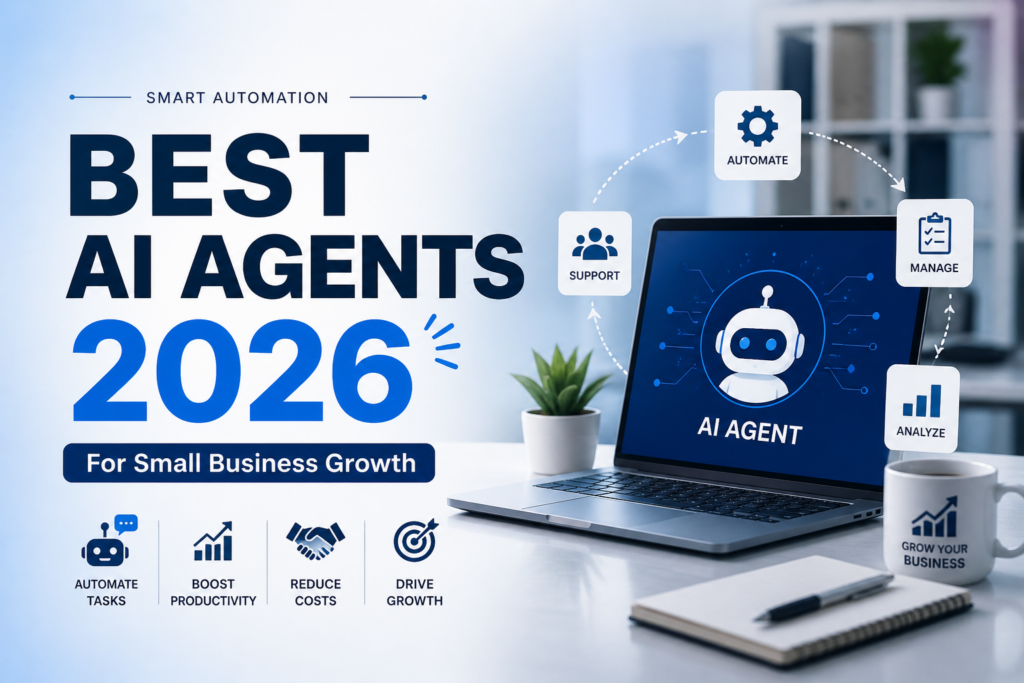
Let’s be honest: most ‘AI’ advice you hear today is fluff. People tell you to use ChatGPT for emails, but they aren’t telling you how to make AI actually do the work. In 2026, if you aren’t using Autonomous AI Agents, you’re basically leaving money on the table.
For the average small business owner, the term “AI” used to mean a chatbot that helped write emails or a tool that generated images. But the landscape has shifted. We have entered the era of Agentic AI—autonomous systems that don’t just suggest actions, but execute them.
If you are looking for the best autonomous AI agents for small business, or trying to understand how to build a multi-agent system, you are at the forefront of a productivity revolution. This guide explores how these “digital employees” are transforming everything from local retail to global supply chain coordination.
Table of Contents
What is an Autonomous AI Agent? (And Why It’s Not Just a Chatbot)
To understand why this matters, we have to look at the “Agency Gap.”
A standard AI (like a basic LLM) is reactive. You give it a prompt; it gives you an answer. An Autonomous AI Agent, however, is proactive. It is given a goal (e.g., “Find the cheapest eco-friendly packaging supplier and negotiate a 10% bulk discount”) and it breaks that goal into sub-tasks:
- Researching suppliers.
- Checking their “green” certifications.
- Drafting and sending emails.
- Comparing responses.
- Reporting the final deal to you.
It functions as a digital worker with a “brain” (the LLM), “hands” (software integrations), and “memory” (database access).
The Best Autonomous AI Agents for Small Business in 2026
Small businesses don’t have the massive IT budgets of Fortune 500 companies. They need “plug-and-play” agency. Here are the top contenders currently dominating the market:
1. AutoGPT and BabyAGI (The Open Source Pioneers)
For the DIY-inclined business owner, these frameworks allow you to set a goal and let the AI browse the web and execute code to reach it. They are excellent for market research and competitive analysis.
2. Microsoft Copilot Studio
If your business runs on Outlook, Excel, and Teams, Copilot Studio allows you to create agents that have “permission” to act within your documents—scheduling meetings, summarizing long email chains, and updating CRM entries autonomously.
3. CrewAI
This is the “manager’s choice.” CrewAI excels at orchestrating groups of agents (a multi-agent system) to work together. You can have one “Researcher Agent” and one “Writer Agent” who pass work back and forth until the job is done perfectly.
The Technical Architecture of Agency: Why “Memory” is the Secret Sauce
Most small business owners make the mistake of thinking an AI agent is just a script. In reality, the difference between a mediocre agent and a high-performance digital worker is Vector Memory.
When you build a system to handle your business, you must provide it with “contextual awareness.” This is done through a process called RAG (Retrieval-Augmented Generation). * Short-term Memory: Allows the agent to remember what you said five minutes ago in a chat.
- Long-term Memory: Allows the agent to remember your brand voice, your pricing tiers, and your preferred shipping partners across weeks of operations.
By integrating a vector database like Pinecone or Weaviate with your agentic system, you create a worker that actually “learns” your business nuances. This reduces the need for constant re-prompting and ensures that the agent’s output remains human-centric and aligned with your specific goals at Global Echo USA.
How to Build a Multi-Agent System: A Step-by-Step Framework
Building a single agent is helpful; building a multi-agent system (MAS) is transformative. Think of it as building a department instead of hiring one freelancer.
Step 1: Define the Roles
Don’t ask one AI to do everything. It leads to “hallucinations” and errors. Instead, assign roles:
- The Analyst: Scans data for trends.
- The Executor: Uses APIs to move data between apps (like Shopify to QuickBooks).
- The Critic: Reviews the work of the other agents for quality control.
Step 2: Establish the Communication Protocol
How will your agents talk to each other? In frameworks like LangChain or CrewAI, you define a “manager” agent that oversees the workflow, ensuring the Analyst’s data is formatted correctly before the Executor uses it.
Step 3: Set Guardrails (Human-in-the-Loop)
For small businesses, total autonomy is risky. Set “checkpoints” where the agent must ask for your permission before spending money, sending a public-facing email, or deleting data.
Strategic Multi-Agent Workflows: Three Templates for 2026
To truly leverage a multi-agent system, you need to move beyond simple tasks. Here are three high-level workflows that small businesses are using right now to save 20+ hours per week:
Workflow A: The Content & SEO Engine
Instead of one AI writing a blog post, you deploy a trio:
- The Researcher: Scrapes current Google Trends and competitor backlink profiles.
- The Creative Writer: Drafts the narrative based only on the Researcher’s verified facts.
- The SEO Optimizer (The “Rank Math” Agent): Adjusts the draft to ensure the focus keyword density is perfect and internal linking is sound.
Workflow B: The 24/7 Customer Success Squad
- The Triage Agent: Scans incoming emails and categorizes them by urgency.
- The Solution Agent: Drafts a response by looking up the customer’s order history and your company’s refund policy.
- The Human Liaison: Notifies you only if the sentiment of the email is “High Frustration,” allowing you to handle the emotional side while the AI handles the logistics.
Workflow C: Market Intelligence & Price Monitoring
If you sell products online, you can’t manually check every competitor. An autonomous agent can be programmed to:
- Monitor five competitor websites daily.
- Track price fluctuations.
- Automatically adjust your store’s pricing within a pre-approved range to ensure you remain the most competitive option.
AI Agents for Supply Chain Coordination: The Game Changer
Perhaps the most profitable use of agentic AI is in supply chain coordination. Small businesses often struggle with inventory management and shipping delays. I remember a client who lost $5k in a single week because of a shipping delay in the Suez Canal—this is exactly the type of disaster an AI agent predicts before it happens.
Predictive Reordering
Instead of you checking stock levels, an AI agent monitors your Shopify store. It sees that a specific product is selling 20% faster than usual. It automatically checks your supplier’s lead times and drafts a purchase order before you even realize you’re running low.
Logistics Optimization
Autonomous AI agents can monitor global shipping ports, weather patterns, and fuel prices. If a storm is brewing in the Atlantic, your Logistics Agent can automatically re-route a shipment or notify your customers of a 2-day delay, maintaining transparency without you lifting a finger.
The “Human” Advantage: Why Autonomous AI Agents Won’t Replace You
There is a common fear that “agents” mean “no more employees.” This is a misconception.
Autonomous AI agents handle the linear, repetitive, and data-heavy tasks. This frees up the human business owner to focus on strategy, empathy, and creativity.
- An AI can optimize a supply chain, but it cannot build a long-term personal relationship with a local artisan supplier.
- An AI can write a report, but it doesn’t understand the “soul” of your brand’s mission.
At Global Echo USA, we believe technology should serve humanity, not replace it. By adopting autonomous agents, small businesses can finally compete with the scale of giant corporations while keeping their local, personal touch.
Deep Dive: Solving the “Bullwhip Effect” with Agentic AI
In supply chain management, the “Bullwhip Effect” occurs when small fluctuations in retail demand cause massive, distorted swings in wholesale ordering. This is the primary reason small businesses run out of stock or over-order.
Autonomous AI agents for supply chain coordination act as a stabilizing force. Because an agent can process millions of data points—from weather patterns to social media trends—it can identify a “viral moment” for your product before it reflects in your sales dashboard.
Imagine an agent that sees a TikTok trend featuring a product similar to yours. It doesn’t wait for you to wake up. It checks your current inventory, realizes you only have 50 units left, contacts your manufacturer in Shenzhen, and secures a production slot for 500 more units. This level of autonomous foresight is what separates the winners from the losers in the 2026 e-commerce landscape.
Avoiding the “AI-Written” Trap: How to Maintain Authenticity
As you scale your use of these tools, the biggest risk is losing your brand’s “soul.” Google’s 2026 algorithms are highly sophisticated at detecting “hollow” content. To stay “Human-Written” in the eyes of search engines:
- Insert Personal Anecdotes: An AI doesn’t know what it felt like when you started Global Echo USA. Share your “Why.”
- Use “Contrarian” Opinions: AI is trained to be helpful and neutral. Humans are often opinionated. Don’t be afraid to say why a popular tool sucks or why a common business trend is a waste of time.
- Varied Sentence Length: AI tends to write in a very rhythmic, predictable pattern. Break the rhythm. Use short sentences for impact. Then, use longer, more complex explanations to show deep expertise.
Conclusion: Starting Your Agentic Journey
The transition to an agentic workflow doesn’t happen overnight. Start small. While many are still stuck on basic chatbots, the real winners in 2026 are those mastering autonomous AI agents to handle the heavy lifting of their business. “Starting your journey with autonomous AI agents is easier than you think.”
- Identify one task that takes you 5+ hours a week.
- Use a tool like Zapier Central or Microsoft Copilot to build a simple agent for that task.
- Monitor, refine, and scale.
The future of business isn’t just “smarter”—it’s autonomous. Are you ready to lead the charge?
Pingback: Japan Earthquakes today 2026: Economic Impact, Business Risks & Financial Lessons