
The surge in US Layoffs 2026 is a clear sign that the American workforce is navigating a period of profound transformation. As of April 2026, the “low-hire, low-fire” equilibrium of previous years has shifted toward a more aggressive restructuring phase. While the broader economy remains resilient in terms of GDP growth, the headlines are dominated by a surge in job cuts across tech, retail, and manufacturing.
If you feel like the ground is shifting beneath your feet, you aren’t alone. Data suggests that 58% of U.S. companies plan to conduct layoffs by the end of 2026, with many of those cuts hitting hardest right now. But why is this happening this month? And what are the real drivers behind these pink slips?
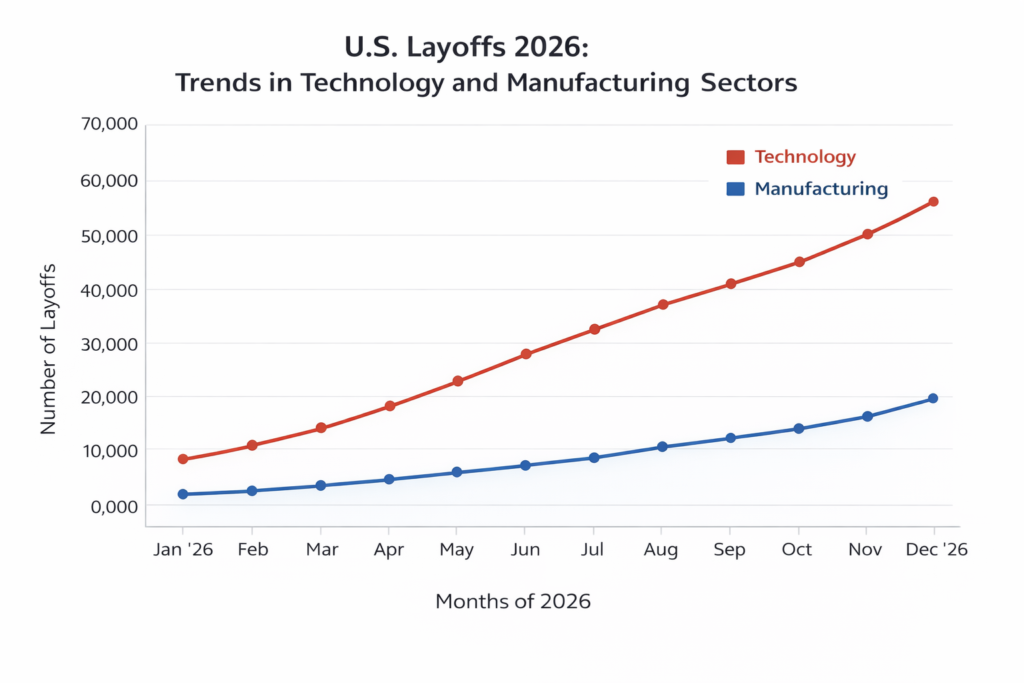
Table of Contents
1. The “AI Pivot”: Restructuring for Automation
The single most significant driver of layoffs in April 2026 is the rapid adoption of Artificial Intelligence. We are no longer in the “speculation” phase of AI; we are in the “implementation” phase.
- Oracle’s Infrastructure Shift: Recently announced a massive reduction of 30,000 roles as it pivots its entire infrastructure toward AI-driven services.
- Big Tech Capital Allocation: Amazon and Meta continue to trim their headcounts (cutting 16,000 and 2,400 roles respectively this quarter) to free up capital for high-end GPU clusters and AI talent.
Companies are not necessarily “failing”—they are trading human hours for algorithmic efficiency. Business leaders report that 35% of current layoffs are directly linked to AI adoption, and nearly 4 in 10 companies expect to replace specific roles with AI by the end of this year.
2. The Tariff Ripple Effect and Trade Policy
April 2026 has seen a sharp uptick in layoffs within the manufacturing and supply chain sectors due to evolving trade policies. Uncertainty regarding tariffs and trade agreements has forced many firms to “batten down the hatches.”
When the cost of raw materials or imported components fluctuates due to new trade barriers, companies often look to labor—their largest controllable expense—to maintain profit margins. 39% of business leaders cite trade policy concerns as a top factor for their current workforce reductions.
3. Post-Pandemic Correction: The Long Tail
It has been years since the 2020-2022 hiring frenzy, but many companies are still “right-sizing.” Between 2021 and early 2026, the tech industry alone has shed over one million jobs. The US Layoffs 2026we are seeing this month from giants like General Motors (1,300 jobs) and The Walt Disney Company (1,000 jobs) are part of a broader effort to shed the “bloat” accumulated during the era of zero-percent interest rates and infinite growth projections.
4. Sector-Specific Struggles: Who is Getting Hit?
The pain is not distributed equally. While some sectors are booming, others are facing a “perfect storm” of high interest rates and declining consumer demand.
Tech and SaaS
The Software-as-a-Service (SaaS) sector remains the hardest hit, accounting for nearly 28,000 layoffs this month. As businesses consolidate their tech stacks to save money, SaaS companies are seeing their revenue growth stall, leading to immediate headcount cuts.
Retail and Logistics
Traditional retail is undergoing a painful modernization. Macy’s and Target have both announced closures and distribution center US Layoffs 2026(totaling over 1,500 roles) as they automate their supply chains.
“There is a push toward leaner, more tech-ready workforces where cost efficiency and agility outweigh tenure,” says Kara Dennison, head of career advising atResume.org.
Manufacturing and Automobile
The transition to Electric Vehicles (EVs) has hit a speed bump. As automakers like General Motors and Lucid Motors adjust their production schedules to match actual market demand rather than hype, thousands of factory and engineering roles have been eliminated this month.
5. The “Silent” Economic Factor: Stagflation Risk
While the official unemployment rate hovers around 4.5%, the fear of stagflation—a rare condition where inflation remains high while growth slows—is making CEOs nervous. The Federal Reserve’s hesitation to cut interest rates further has created a “wait and see” environment. Rather than hiring for growth, companies are “hiring for survival,” which often translates to cutting existing staff to protect the bottom line.
| Company | Industry | Estimated Jobs Cut (April 2026) |
| Oracle | Technology | 30,000 |
| General Motors | Automobile | 1,300 |
| Walt Disney | Media | 1,000 |
| Clearwater | Manufacturing | 20% of Workforce |
| Retractable Tech | Technology | 16% of Workforce |
6. Who Is Most at Risk during the US Layoffs 2026?
The US Layoffs 2026 wave has a specific profile. Unlike previous recessions that hit entry-level workers hardest, this wave is targeting:
- High-Salary Employees: 48% of companies say senior roles are the most vulnerable as firms look for “immediate savings in payroll.”
- Workers Without AI Skills: 46% of at-risk employees are those whose roles can be augmented or replaced by automation but who haven’t yet upskilled.
- Middle Management: As organizations move toward “flatter” structures to increase speed, middle-management layers are being purged.globalechousa
7. How to “Layoff-Proof” Your Career in 2026
While no job is 100% safe, you can significantly decrease your vulnerability by following these three steps:
- Develop “AI-Fluency”: You don’t need to be a coder, but you must know how to use AI tools to double your productivity. Companies are keeping the people who can do the work of three using automation.
- Focus on “Human-Only” Skills: Critical thinking, complex negotiation, and emotional intelligence are the hardest things for AI to replicate. Double down on these.
- Stay Mobile: The Staffing Industry Analysts report that while full-time roles are shrinking, “flexible” and contract roles are actually growing. Being open to project-based work can keep your income steady during the transition.
Frequently Asked Questions About US Layoffs 2026
- Are these layoffs a sign of an upcoming recession?
While mass layoffs often signal economic cooling, the 2026 trend is unique. Many firms are conducting “structural layoffs” rather than “cyclical” ones. This means they are cutting staff to reinvest in AI and automation, even while their revenues remain stable. It is less a sign of a total economic collapse and more a sign of a massive industry shift.
- Which states are seeing the most job cuts?
Currently, California (Tech), New York (Finance), and Texas (Manufacturing/Energy) are seeing the highest volume of filings. However, as remote work roles are eliminated, the impact is being felt nationwide rather than being contained to specific geographic hubs.
- How long do these restructuring phases typically last?
Economic analysts suggest that the “AI integration” phase of the labor market may continue through late 2027. Companies are currently testing how many roles can be successfully automated, leading to rolling layoffs rather than a single one-time event.
Conclusion
The US Layoffs 2026 we are witnessing this April are not just a sign of a bad economy — they are a sign of a new economy. The convergence of AI, shifting trade borders, and a post-pandemic correction is forcing a massive reshuffling of the American workforce.
While the headlines are unsettling, this period of “creative destruction” will eventually lead to new industries and roles that we can’t yet imagine. For now, the best strategy is to stay informed, stay agile, and keep your skills sharp.
“How is your industry holding up in 2026? Drop a comment below and let’s discuss the shift.”