If you’ve ever stood outside just before a thunderstorm, you know that eerie pause — the wind stops, the air thickens, and for a moment everything feels charged. I’ve chased that feeling since I was a kid. But as much as I love watching a storm roll in, I also know the same sky that mesmerizes me can kill in an instant.
Every summer, somewhere on Earth, someone becomes a statistic in a report labeled death by lightning. I always find that phrase oddly calm for something so violent. Lightning doesn’t just strike; it rearranges air, melts sand, and sometimes stops a human heart before the thunder even arrives.
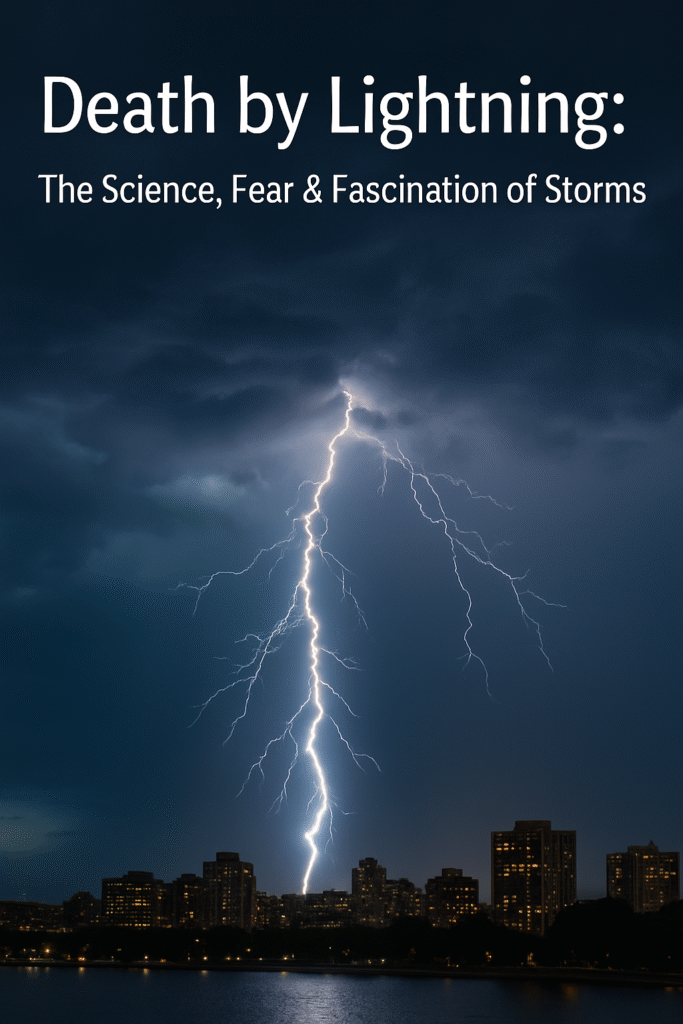
Why Lightning Fascinates People Like Me
I’m not a storm chaser — I’m a storm watcher. I keep the windows cracked open during a thunderstorm, smell that metallic scent in the air, and count the seconds between flash and rumble. It’s nature showing off its math and beauty at once.
Lightning, at its simplest, is electricity looking for balance. Inside a storm cloud, ice and water particles crash together, separating positive and negative charges. Eventually the difference becomes too great to hold, and the sky releases it all in a blinding burst. That flash is hotter than the surface of the sun — around 50,000 °F.
When I learned that in middle school, I remember thinking, How does anyone survive that? Turns out, sometimes they don’t.
What Really Happens During a Lightning Strike
“Instant death” sounds clean, but it’s messy physics. A bolt can carry hundreds of millions of volts, traveling through or around a body in less than a thousandth of a second. If it crosses the heart, cardiac arrest is immediate. If it travels over the skin, the person might live but carry strange fern-shaped scars called Lichtenberg figures — electric trees etched into flesh.
Survivors describe it as being hit by an invisible wall. Their shoes explode, fillings melt, or eardrums rupture. Some wake up meters away with no memory of falling. The lucky ones breathe again. The unlucky never know what hit them.
People Who Met Lightning and Lived to Tell It
I still can’t believe Roy Sullivan’s story is real. He was a U.S. park ranger struck by lightning seven times between 1942 and 1977 — and survived each one. His hat burned, his hair singed, yet he kept working outdoors. Later in life, he said thunderstorms made him physically sick with fear. That’s the strange part: the human brain can adapt to almost anything, even the thing that nearly killed it.
Another story that stuck with me came from a hiker in Colorado who survived a strike that killed her friend standing just two feet away. She said it sounded like “a camera flash inside my skull.” Reading her interview made me realize lightning deaths aren’t freak accidents; they’re reminders of how thin our safety bubble really is.
History’s Complicated Relationship with Lightning
Before we understood electricity, lightning was divine judgment. Ancient Greeks gave it to Zeus, Norse mythology handed it to Thor, and African traditions spoke of gods who hurled bolts to cleanse or punish.
In colonial America, churches were frequent victims — tall steeples reaching toward heaven, perfect targets. Congregations sometimes interpreted strikes as moral warnings. Then along came Benjamin Franklin with his kite experiment, proving that lightning was simply electricity from the sky.
By the late 1800s, when James Garfield was president, people were finally treating storms as natural phenomena, not spiritual omens. Garfield himself, a thoughtful, science-minded man, admired Franklin’s experiments. During his short presidency he often spoke about how education and curiosity could turn fear into knowledge — a mindset that eventually saved countless lives through the invention of the lightning rod.
The Anatomy of a “Death by Lightning”
When people ask what a strike actually does, I usually tell them it’s like the body becoming a wire for a split second. Current surges through, nerves misfire, muscles contract violently. The heart’s electrical rhythm — the thing that keeps you alive — suddenly competes with a cosmic version of itself.
Pathologists who study lightning fatalities often note something eerie: many victims appear almost peaceful. Their hearts stopped before trauma could set in. Clothes might be torn or smoldering, but the skin can look untouched except for those branching red marks that fade in hours.
It’s the quiet aftermath that gets to me — the way such enormous power leaves so little behind.
Where Lightning Kills Most
If you live in Florida, you already know it’s called the lightning capital of the United States. Warm, humid air plus sea breezes equals perfect storm fuel. Globally, the region around the Congo Basin in Africa sees more flashes than anywhere else on Earth.
Statistically, men account for about 80 percent of lightning deaths, mostly from outdoor work or recreation — farmers, fishermen, hikers, golfers. The most dangerous time? Summer afternoons, when storms sneak up fast.
Modern numbers are lower than ever: in the U.S., about twenty to thirty people die by lightning each year. A century ago it was hundreds. The difference? Awareness and shelter.
Myths That Refuse to Die
Every time lightning season comes around, I still hear people repeat myths that could kill them:
- “Lightning never strikes twice.” Tell that to the Empire State Building — it’s hit a hundred times a year.
- “Rubber shoes protect you.” Not even close. A bolt jumps through miles of air; half an inch of rubber won’t stop it.
- “If you’re under a tree, you’re safe from rain.” True about rain, false about electricity. Trees channel current straight to the ground — and through anyone touching them.
- “A struck person is electrified and unsafe to touch.” Completely wrong. Their body doesn’t hold a charge. If you can start CPR, do it immediately.
Knowing these things feels simple, but in the moment panic and superstition still win. Education — the same value Garfield preached — saves lives.
What to Do When the Sky Turns Dangerous
Here’s what the data — and a lifetime of weather watching — says works:
- Go indoors the moment you hear thunder. If you can hear it, lightning can reach you.
- Avoid water — lakes, pools, even showers. Water conducts perfectly.
- Stay off wired electronics; a strike miles away can ride power lines into your house.
- If caught outside, crouch low on the balls of your feet, minimize ground contact, and stay away from tall isolated objects.
I’ve had to use that last one once while camping in Utah. The storm rolled in faster than expected. I remember crouching between boulders, counting flashes, heart racing, realizing how fragile we are compared to the sky.
The Science Nerd in Me Can’t Help but Marvel
Every time I read about the physics of a strike, I get that same thrill I did as a kid. Imagine: clouds miles above us storing energy equivalent to a small nuclear bomb, releasing it in a blink, all because positive and negative charges wanted equilibrium.
We think of lightning as chaos, but it’s actually order — the universe balancing its checkbook. The idea that such destruction is also a form of harmony blows my mind.
Lightning in Culture and Art
Artists have always used lightning as a metaphor for sudden change. Painters like Turner captured its violent light over calm seas. Poets call it a flash of truth. Scientists, though, see it as a question mark — what triggers one bolt over another? Why do some people live?
Even our language borrowed from storms: a bolt from the blue, spark of genius, electrifying performance. It’s funny how something that kills can also symbolize inspiration.
The Role of Chance
One of my favorite science quotes says, “Probability is the measure of our ignorance.” That’s lightning in a nutshell. You can’t predict where it’ll land, only the odds. You could stand beside a hundred people and be the one who takes the hit.
There’s humility in that. It reminds me of those old stories from Garfield’s 19th-century America, when people first realized that understanding nature didn’t mean controlling it. You can ground a building, but you can’t bargain with the sky.
How Modern Tech Helps (and Sometimes Hurts)
Weather apps, radar alerts, and lightning trackers have cut fatalities dramatically. My phone now buzzes if lightning strikes within ten miles. But the flip side is false security. We film storms instead of fleeing them, convinced a camera lens will protect us.
I’ve done it too — stood on a porch trying to capture the “perfect lightning shot,” forgetting that electricity doesn’t care about my enthusiasm. The difference between awe and arrogance is often one heartbeat.
The Survivors’ Perspective
Lightning survivors I’ve read about often talk more about after than during. They wake up with brain fog, constant fatigue, ringing ears, or memory gaps. Doctors call it post-lightning syndrome. Some can’t stand loud noises anymore; others develop anxiety whenever clouds darken.
A few find strange beauty in survival. One woman wrote, “Every scar is a reminder that I’ve already met the sky and walked away.” That line sticks with me every time thunder rolls.
Lessons from History: Garfield’s Generation
Back to James Garfield for a moment. His time marked humanity’s shift from fearing nature to studying it. The same decade saw new observatories, telegraph weather reports, and early storm warnings. Garfield believed education was the backbone of democracy — and that included understanding the world’s physical laws.
Because of that spirit, lightning went from mystical curse to manageable risk. We built lightning rods, grounded power grids, and developed modern meteorology. In a roundabout way, his era’s curiosity still saves lives today.
Why We’re Still Drawn to Storms
Despite everything we know, people still run outside to watch lightning. I think it’s because storms make us feel connected — to each other, to the planet, to something vast. There’s honesty in that fear and fascination.
Whenever I see a bolt split the sky, I’m reminded of how much energy exists in simple opposites: negative and positive, earth and air, curiosity and caution.
Maybe that’s the real lesson in every death by lightning story — that understanding power doesn’t mean eliminating it. It means respecting it.
Numbers That Bring It Home
A few quick facts I keep bookmarked:
- Roughly 2,000 people worldwide die by lightning each year.
- In the U.S., 90 percent of strike victims survive, often with injuries.
- The odds of being struck in your lifetime are about 1 in 15,000 — higher if you love golf or hiking.
- The loudest recorded thunder measured 235 decibels, enough to rupture eardrums miles away.
Stats don’t replace stories, but they give shape to the awe.
What Lightning Teaches About Being Human
If you strip away the fear and fascination, lightning is just energy doing what energy does — moving from imbalance to balance. But to me it’s more than that. It’s proof that we live inside a planet still alive with mystery.
It humbles me the same way reading about Garfield’s curiosity does: a reminder that learning is our shield against superstition, but not against mortality. Even with all our science, one flash can still turn day into memory.
Closing Thoughts
I’ve watched hundreds of storms since childhood. Some gentle, some terrifying. Every one of them whispered the same thing: respect.
So next time thunder rolls and the sky lights up, step inside, pour yourself a cup of coffee, and watch through the window. Feel small, but safe.
Because for all our technology and reason, we’re still guests here — borrowing space beneath a restless sky that occasionally reminds us who’s really in charge.
And that, to me, is what makes lightning both terrifying and beautiful.
For safety resources and real-time strike maps, visit the National Lightning Safety Council.